Where the Pavement Ends
A gravel road in the middle of Omaha becomes a dusty path back through memory, ancestry and the people who helped shape the road home.
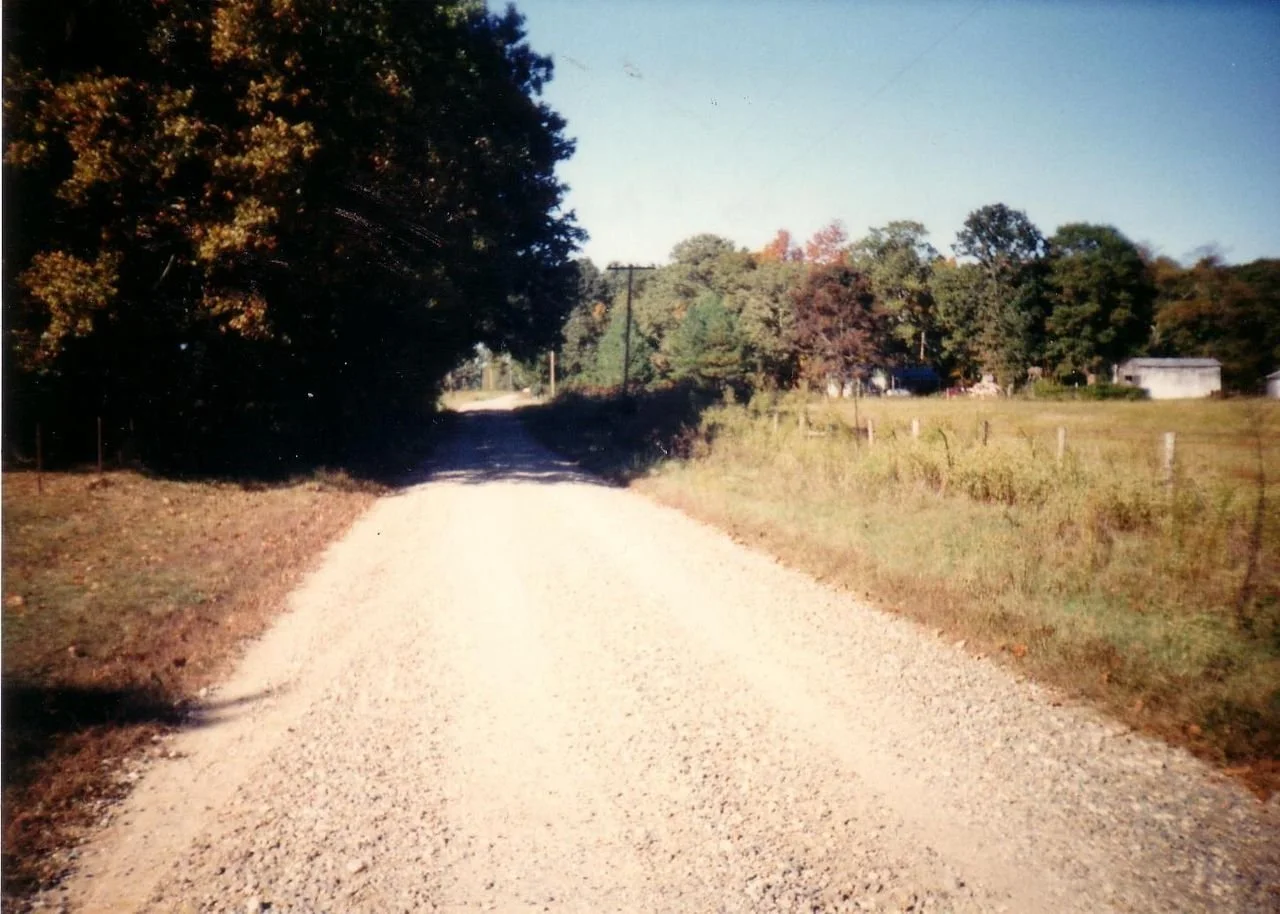
The picture from the gravel road in Arkansas leading to the cemetery where some of my relatives are buried
Pockets of Omaha still have gravel roads – even in the middle of the city, which fascinates me.
Our recent move placed us near a major road reconstruction project, making the access point to our neighborhood a gravel road that branches off a major road. I learned the road might be a leftover farm lane from before the city grew around it.
That may very well be true. Not far away, you’ll find waving cornstalks that are definitely higher than “knee high by the fourth of July,” as the old saying goes.
Why does any of this matter? I guess it doesn’t in the big scheme of things, but gravel roads stir so much.
Dust is always present, settling on trees, cars, homes – anything that is stationary – as I creep down the road at a snail’s pace. Rocks ping the undercarriage of my car as I navigate seemingly hidden ruts and potholes. And no lane markers exist, making me feel like I’m out in the country.
Symbolically, the road represents a slower life, a life less polished, unfinishedness (which doesn’t sound like a word but actually is) and maybe the long way home. But in reality, it’s the shortest route to our house – at least for now. The county’s website says the project is expected to be completed by June/July 2026.
Traveling that gravel road every day takes me back to another gravel road not all that far from here. I was 15, I think, and learning how to drive in my grandpa’s blue, 1970s-era GMC truck. I gripped the steering wheel for dear life anytime another vehicle approached – a fear I carried with me to the paved streets of Omaha. But after a few trips down the gravel road, I felt more confident when it came time to take my driver’s test. And I passed on my first attempt.
Fast forward 10 or 15 years, and I’m on another gravel road in rural Arkansas. My grandmother wanted to visit a cemetery that was quite a ways off the beaten path because some of our relatives are buried there. I snapped a picture of the gravel road that day once we pulled up to the cemetery and it hung on my wall for years. I think I hung it because it made me feel connected to my ancestors. Or maybe to my grandmother.
The Bible is full of genealogies because each generation matters. Deuteronomy 32:7 (ESV) tells us, “Remember the days of old; consider the years of many generations; ask your father, and he will show you, your elders, and they will tell you.”
For me, gravel roads are significant because they slow me down enough to remember where I’ve been, and sometimes, who brought me here.